SchoolBud
Turning Real-World Homework into an Adventure
A conceptual product design project exploring how playful, interactive 3D game universes and strategic business models can motivate children to engage with real-world learning tasks.
Role: Founder · Product Strategist · 3D Environment Artist
Core Focus: Product Strategy · Game Mechanics · Business Monetization · 3D Design
Tools: Figma · Blender · Unity
Timeline: 2024 (Founder Concept & Strategic Prototype)

Context & Strategic Challenge
Homework can feel repetitive, abstract, and disconnected from the interactive environments children naturally find engaging. Modern digital games, meanwhile, excel at driving engagement via clear goals, immediate feedback loops, storytelling, and rewarding progression systems.
The Product Innovation: SchoolBud explores how those motivational game qualities can support and drive real-world learning rather than replace it.
The Business Concept:
What if offline homework unlocked the game? SchoolBud connects physical learning activities with a digital world. Completing real-world tasks acts as the core mechanism that unlocks characters, rewards, challenges, and new 3D areas to explore:
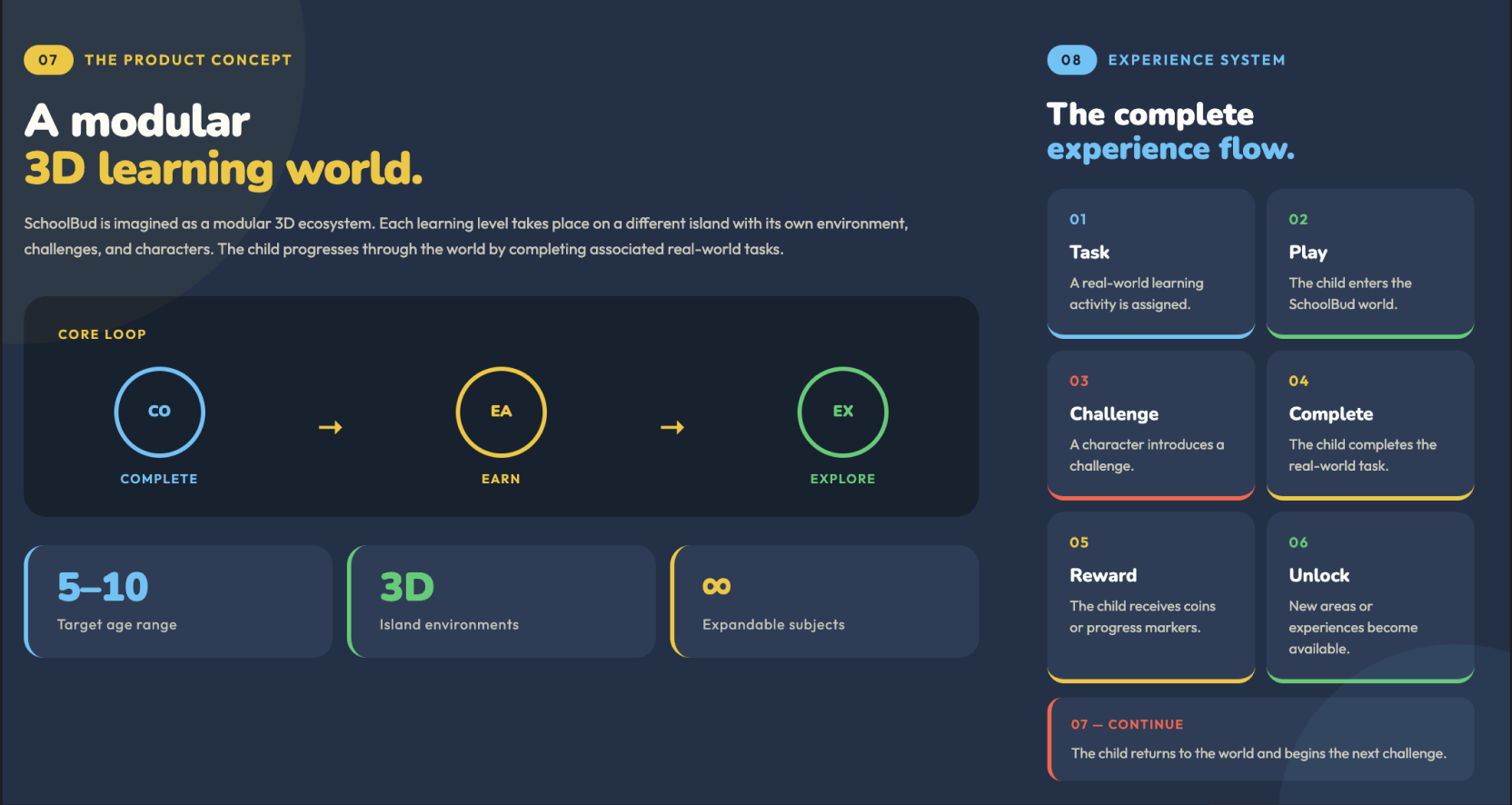
Real-World Task ➔ Completion ➔ Reward ➔ Digital Progress ➔ Exploration
The Strategic Goal: Create an ecosystem where real-world learning drives digital progression, rather than simply encouraging children to spend more time inside an app for the sake of screen time.


Multi-Stakeholder Strategy (Designing for the Triad)
To build a sustainable educational product architecture, I engineered the SchoolBud foundational framework to balance the distinct constraints of three essential pillars:
For Children: Delivered explicit goals, empathetic guidance characters, immediate feedback loops, and highly visible progression tracks.
For Adults: Established a meaningful, trusted connection between digital progression and verifiable real-world learning tasks across multiple academic subjects.
For the Product & Business: Engineered a highly scalable, flexible system that can expand across subjects, characters, environments, and learning activities without increasing interface complexity.
Gamification & Design Research
Rather than deploying arbitrary point systems, I conducted exploratory design research into child psychology, learning motivation, and spatial game worlds to draft four core product principles:
Learning First: Digital progression and game rewards are strictly structured to support and validate real-world learning, never to replace it.
Radical Simplicity: While the underlying monetization, system rules, and database logic are highly complex, the child's interaction stays clear and intuitive.
Characters Connect: Avatars provide guidance, feedback, personality, and motivation, acting as the primary interactive layer for the player.
Built for Expansion: The business model and game engine are designed so new subjects, characters, environments, and stories can continuously scale within the same system.

Experience Architecture & Monetization Loops
I mapped the entire product experience around a repeatable, high-retention progression cycle that establishes a clear relationship between effort, reward, and business sustainability:
Task: A real-world, offline learning activity is assigned.
Play: The child enters the SchoolBud 3D world.
Challenge: An interactive character introduces a localized micro-objective.
Complete: The child executes and verifies the associated real-world homework task.
Reward: The child receives in-game coins, turning abstract effort into a tangible asset.
Unlock: New map islands and narrative experiences open up for exploration.

Creative Direction & The 3D Production Pipeline
To transform this venture from a strategic hypothesis into a tangible proof-of-concept, I acted as the creative director and 3D artist, building a cross-discipline workflow to visualize the game's universe:
Product Strategy & Monetization Framework: Engineered the underlying business architecture, mapping out user retention loops, scalable subject modules, and value propositions for school and parental adoption.
Blender (3D Asset Design): Modeled a fully custom, stylized, low-poly 3D asset library. I designed the unique character guides, environmental props, and landscape terrains to establish the visual identity of the brand.
Unity (Spatial Composition): Assembled the assets into interactive 3D biomes, building real-time lighting systems and camera viewpoints to demonstrate how the spatial game mechanics would feel to a young audience.
The Gamified Business & Spatial Ecosystem
The final concept unifies educational psychology, game mechanics, and a scalable product ecosystem into a powerful market opportunity.
Modular 3D Learning Islands: Imagined as a floating archipelago where each interactive island represents a unique academic subject marketplace (e.g., Math, Science, Reading) that can expand over time.
Narrative Character Guides: Fully custom characters engineered to act as the primary interface. They drive the storytelling, guide the player, and deliver motivation, removing the need for traditional text menus.
Tangible Economy & Progress Loops: Abstract homework completion is converted into 3D collectible coins. This translates real-world effort into digital purchasing power within the game's economy, making progress exciting and visible.
Scalability & Strategic Retrospective
Because SchoolBud was developed as a concept prototype, the future business roadmap focuses on infinite ecosystem scalability and monetization strategies:
New Subjects: Expanding into math, science, reading, language, and other targeted learning areas.
New Subject Islands: Launching subject-specific biomes with their own unique visual identities, mechanics, and subscription or unlock tiers.
Seasonal Stories: Deploying limited-time narrative experiences and events built around different environments to maintain long-term user retention.
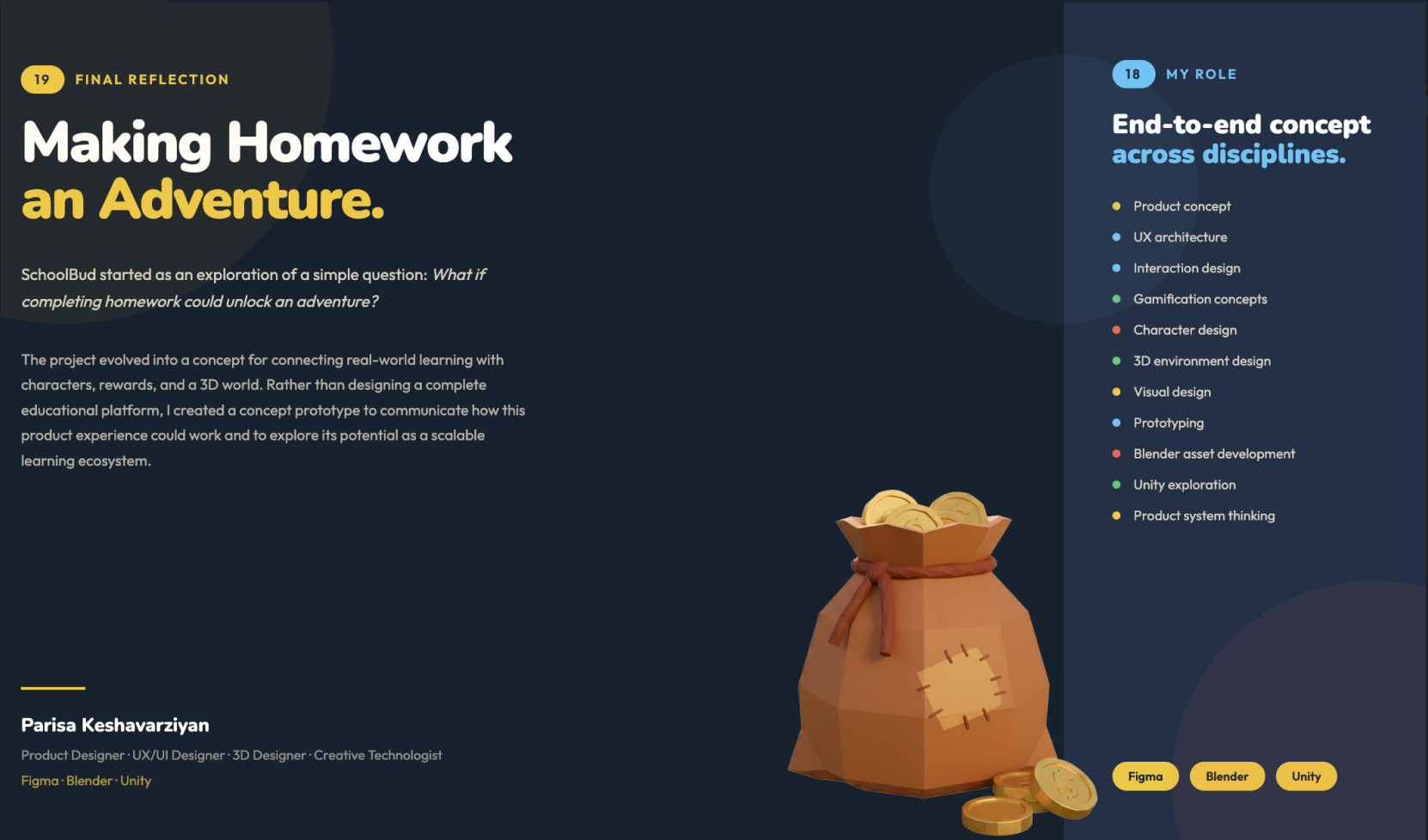
The Founder's Retrospective: SchoolBud brought together product strategy, business design, 3D modeling, visual storytelling, and creative technology. The project challenged me to think far beyond traditional 2D mobile screens and consider how interfaces, characters, game economies, and rewards work together as one cohesive product ecosystem. It proves a foundational design principle: A strong digital experience doesn't have to compete with the real world; it can make meaningful real-world actions feel much more engaging.


